![Report: Comparison of standardization & geocoding services [ranking]](https://algolytics.com/wp-content/uploads/2026/06/pexels-googledeepmind-17485657-4-1024x576.jpg)


 14 minutes
In most production machine learning systems, the primary bottleneck is not the model itself. Putting a model behind an API is relatively straightforward. What actually takes time, drives cost, and introduces risk is everything around it - data preparation, feature engineering, orchestration, integration with external systems, and the decision logic built on top.
That’s the part of the system that determines whether an ML project scales or gets stuck at the proof-of-concept stage.
This article explains how an integrated MLOps platform helps teams move from model development to real-time business impact faster, with lower infrastructure and engineering overhead.
Key Takeaways
- A production ML application is much more than a single machine learning model. Real production ML systems require input validation, feature retrieval, model serving, business logic, APIs, and monitoring to function effectively.
- Algolytics combines AutoML, Scoring.One, and Event Engine to shorten the path from notebook to production from weeks to hours in selected scenarios.
- Under a predefined workload of ~150 predictions per second with millisecond latency, platforms alternative to Scoring.One proved over 20× more costly for comparable model performance.
- Low-code orchestration and real-time feature engineering support use cases such as credit scoring, fraud detection, customer intelligence, and location intelligence with less DevOps overhead.
- Buyers should evaluate an MLOps platform by latency, cost per prediction, real-time feature support, governance, deployment flexibility, and the effort needed to build a full application.
What Is an MLOps Platform in 2026?
MLOps, or machine learning operations, applies engineering and operational practices to the full lifecycle of ML systems - from development and deployment to monitoring and continuous improvement. While rooted in DevOps, it introduces additional complexity driven by data pipelines, feature engineering, and the need to continuously adapt models in production.
After two decades of data science and AI projects across industries such as finance, telecom, e-commerce, energy, and logistics, one pattern is consistent: the bottleneck is no longer training the model. The real challenge is industrializing ML systems - making them reliable, scalable, and maintainable in production.
Typical use cases include credit scoring, fraud detection, marketing optimization, customer intelligence, and real-time decision systems, where latency, cost, and system complexity matter as much as model accuracy.
From Model to Application: Core Components of a Modern MLOps Platform
A production-grade MLOps platform must cover four functional areas:
- Model creation through AutoML and expert modeling.
- Orchestration and ML model deployment.
- Real-time features, data collection, and data management.
- Monitoring, governance, and rollback.
Algolytics uses three integrated components:
- Advanced Miner and Automatic Business Modeler for AutoML, model training, model evaluation, and new models.
- Scoring.One for orchestration, rules, APIs, model registry, model versions, and model deployment process management.
- Event Engine for stream processing, fresh data, feature vectors, and real-time feature store capabilities.
Machine learning models are only one block in the graph. A production scenario may start with input data, validate it, retrieve features, run multiple models, apply business rules, produce model predictions, and send outputs to CRMs, core banking systems, queues, or web applications.
A mature platform should support multiple inference patterns, including batch processing, real-time APIs, and streaming or event-driven inference. Real-time deployment allows online ML models to be updated continuously and generate predictions rapidly as new data comes in, requiring high-performance computing infrastructure for low-latency requests. Batch deployment processes data inputs offline, grouping datasets into batches to be applied periodically to machine learning algorithms, making it suitable for large volumes of data.
Why “We Deployed a Model” Is Not Enough
When teams say they deployed a machine learning model, they usually mean deploying a single artifact - a .pkl file, PMML file, or container. In reality, that is only a small part of the problem.
Whether an ML system actually works in production depends on everything around the model: integration with transactional systems, consistency between training and serving environments, business rules, latency guarantees, error handling, prediction logging, and monitoring.
A model that performs well in isolation does not guarantee a working system. Production requires reliable data ingestion, feature pipelines, and the ability to observe and control model behavior over time.
Containerization helps standardize deployment, but it does not solve issues such as feature drift, data quality, or changing business rules. For example, a fraud detection model may work in a notebook but fail in production without a real-time feature pipeline, drift monitoring, or the ability to update thresholds during periods of increased risk.
Across production ML systems, this pattern is consistent: the challenge is not deploying the model itself, but building the surrounding system that makes it usable, reliable, and maintainable.
Organizational and Technical Blockers in Real ML Projects
We distinguish four recurring blockers in production ML systems: deployment complexity, integration complexity, performance constraints, and rising infrastructure costs.
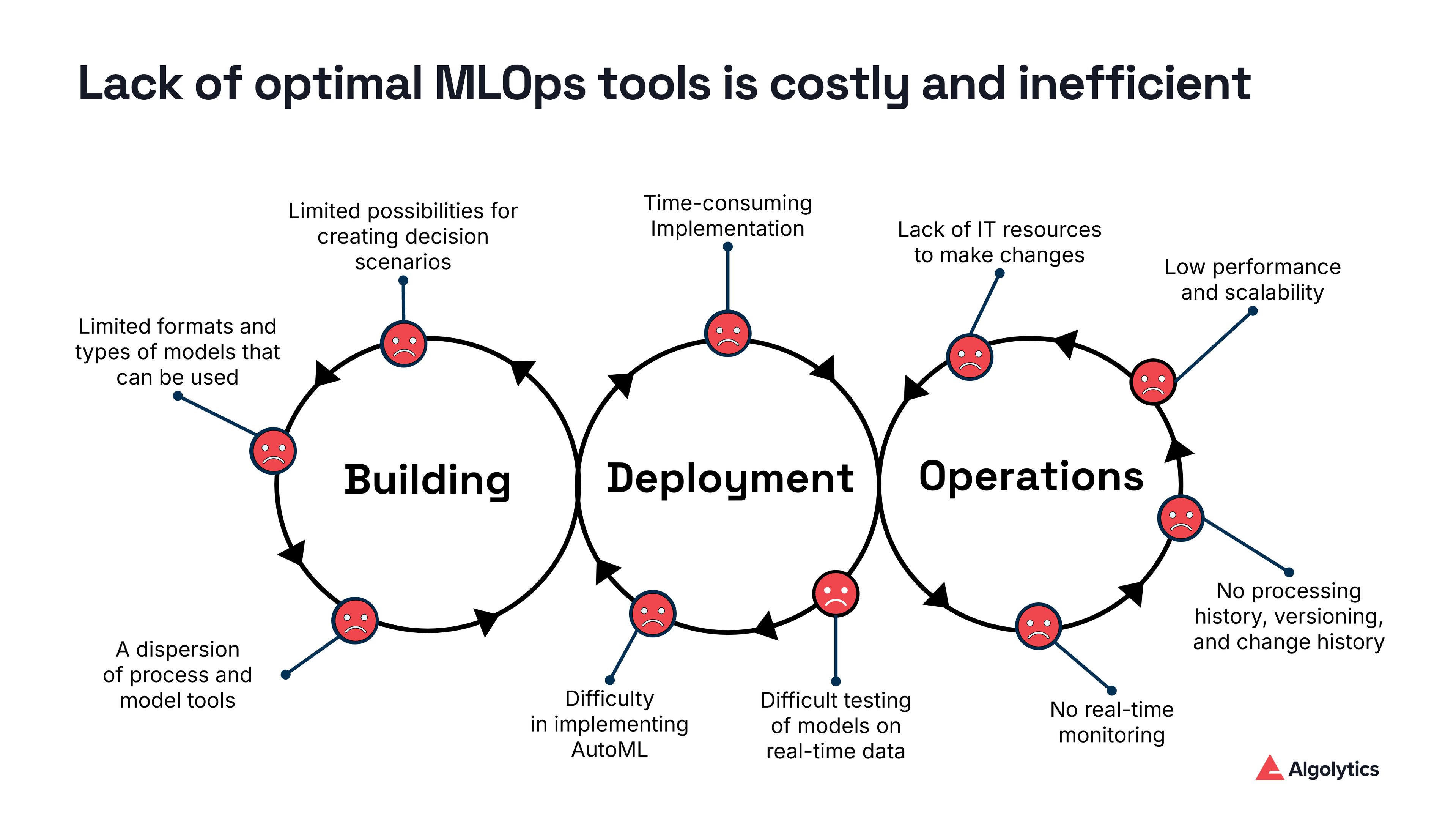
These challenges are often amplified by fragmented workflows. In many organizations, data scientists, ML engineers, software engineers, and DevOps teams operate separately - each owning a different part of the process. This slows deployment, increases coordination overhead, and makes frequent model updates difficult.
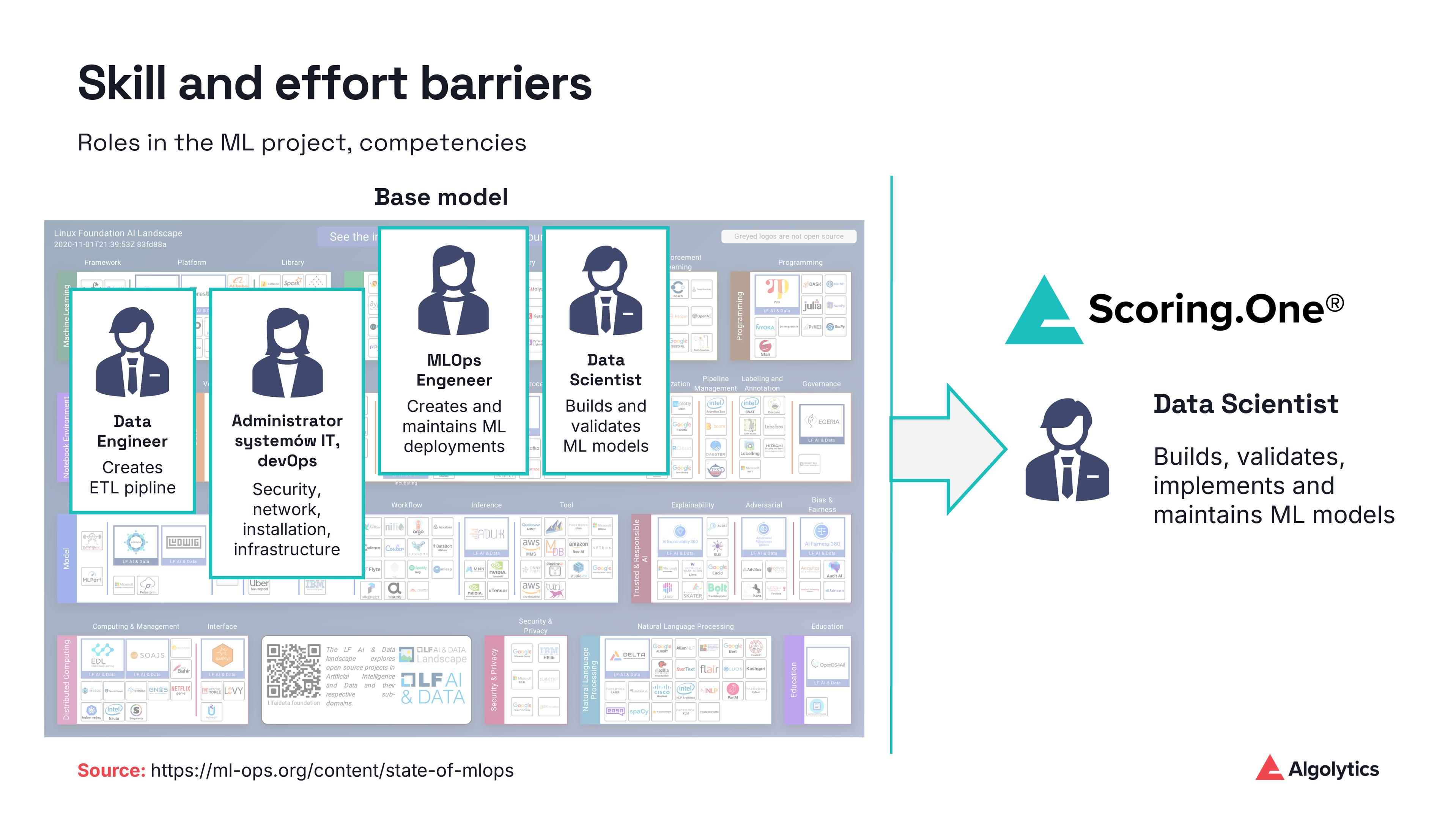
In practice, many teams still rely on scripts, manual approvals, and ad hoc processes rather than fully integrated pipelines. As a result, moving from experimentation to production remains slow and error-prone.
What’s missing is system-level integration: continuous validation, monitoring, and the ability to detect data or model changes early - before they impact business outcomes.
Algolytics Architecture: An Integrated MLOps Platform
Algolytics is designed as a unified MLOps platform rather than a collection of isolated tools, addressing the fragmentation issues described earlier.
The platform is built around three core components that work together as a single system.
The AutoML layer supports model development by helping teams build, compare, and validate models with minimal code. Importantly, model selection is not driven only by predictive performance, but also by how efficiently a model can operate in production.
Scoring.One serves as the central orchestration and execution layer. It integrates model deployment, business rules, APIs, and system logic into a single workflow. Models can be deployed from multiple sources - including AutoML, Python, R, and PMML - allowing teams to move existing models into production without rebuilding them.
Event Engine handles real-time data processing and feature generation. It ingests streaming data such as transactions or user events, aggregates them, and maintains up-to-date feature vectors used during model inference.
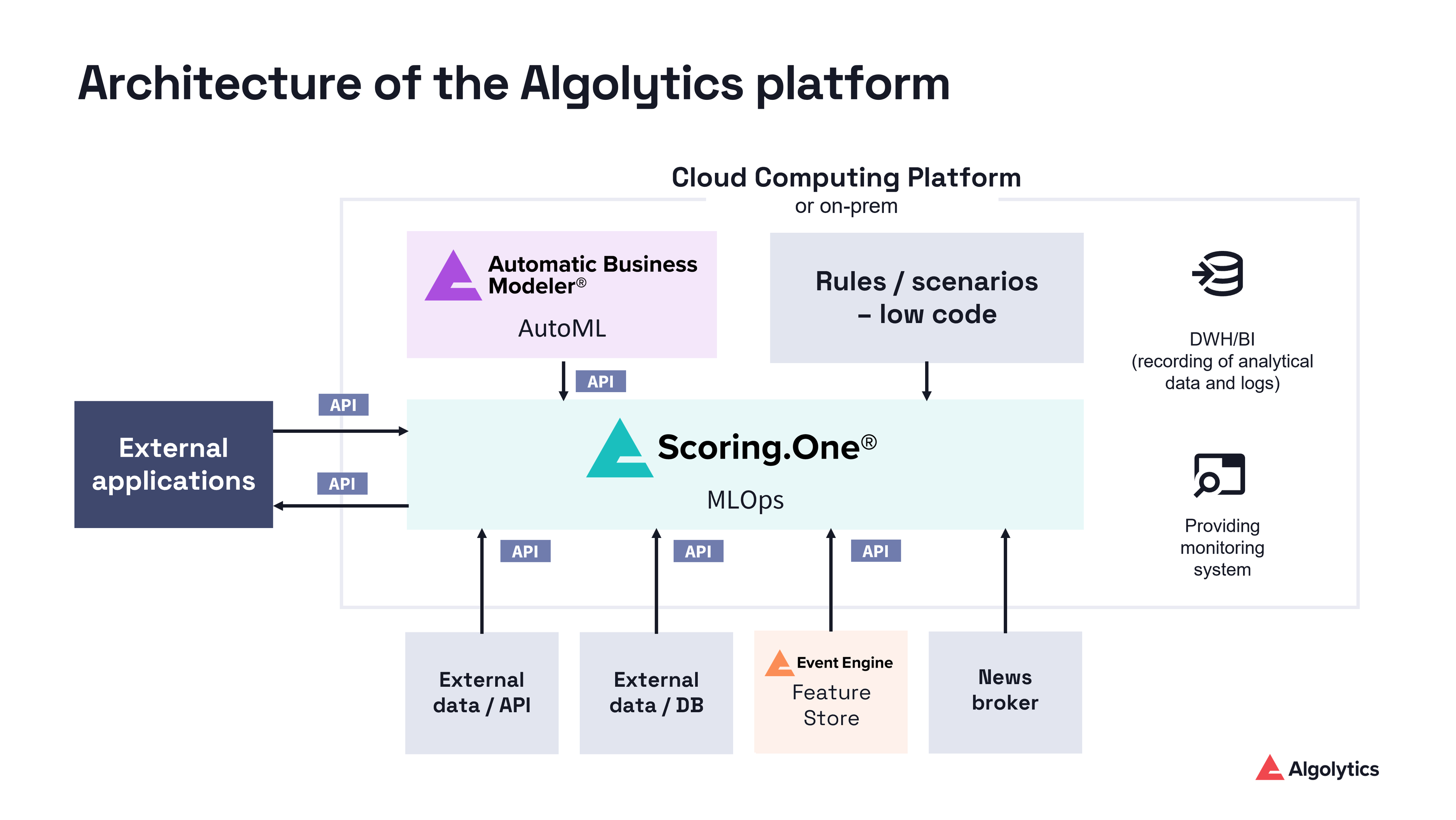
Together, these components form an end-to-end system that combines data processing, feature engineering, model execution, and decision logic within a single architecture.
This integrated approach reduces the need for separate tools, simplifies deployment, and enables real-time decision-making at scale.
The platform can be deployed on-premise, in the cloud, or in hybrid environments - an important capability for regulated industries where data cannot always be moved to public cloud systems.
Designing for Speed and Cost: How the Platform Optimizes Inference
We conducted a benchmark using the same dataset to train models across multiple AutoML platforms. Each model was deployed as a service and evaluated under a load of approximately 150 queries per second.
The results were consistent: predictive accuracy was similar across platforms, with only minor differences in model performance. However, inference speed and infrastructure cost varied significantly.
In some cases, alternative solutions were more than 20× more costly. This highlights a key production insight: when accuracy is comparable, the cost of serving predictions becomes the primary differentiator.
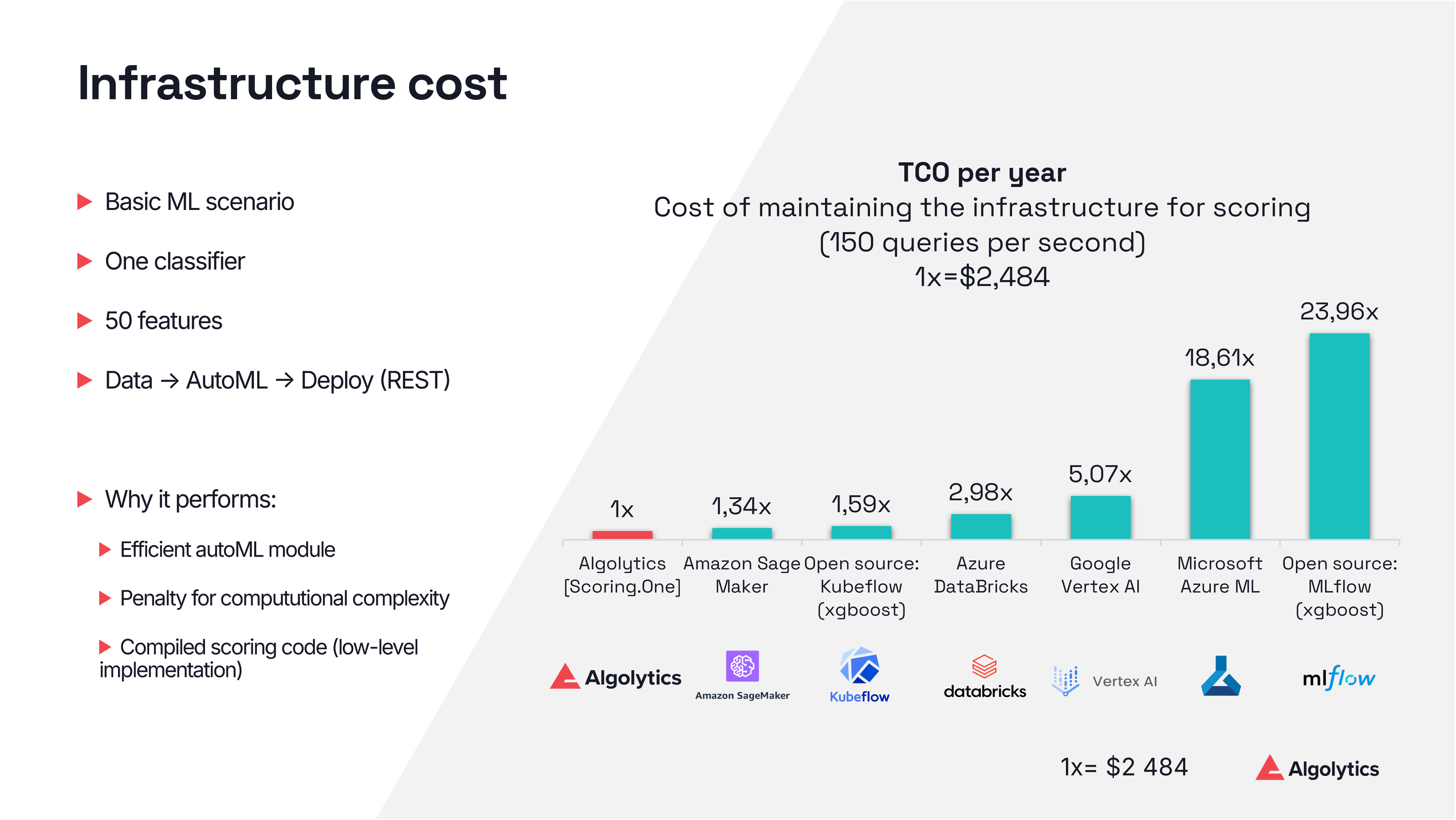
This is addressed through two design choices.
First, model selection takes computational complexity into account. Many models achieve similar accuracy but differ significantly in runtime cost. Choosing simpler models can reduce latency and infrastructure requirements without materially affecting business outcomes.
Second, models can be executed as optimized scoring code, rather than relying on general-purpose runtimes. Since model inference is ultimately a sequence of numerical operations, executing it as compiled code reduces overhead, improving latency and resource efficiency.
Low-Code Orchestration in Scoring.One
Scoring.One uses a visual, block-based interface, where decision flows are defined as diagrams rather than implemented as separate microservices.
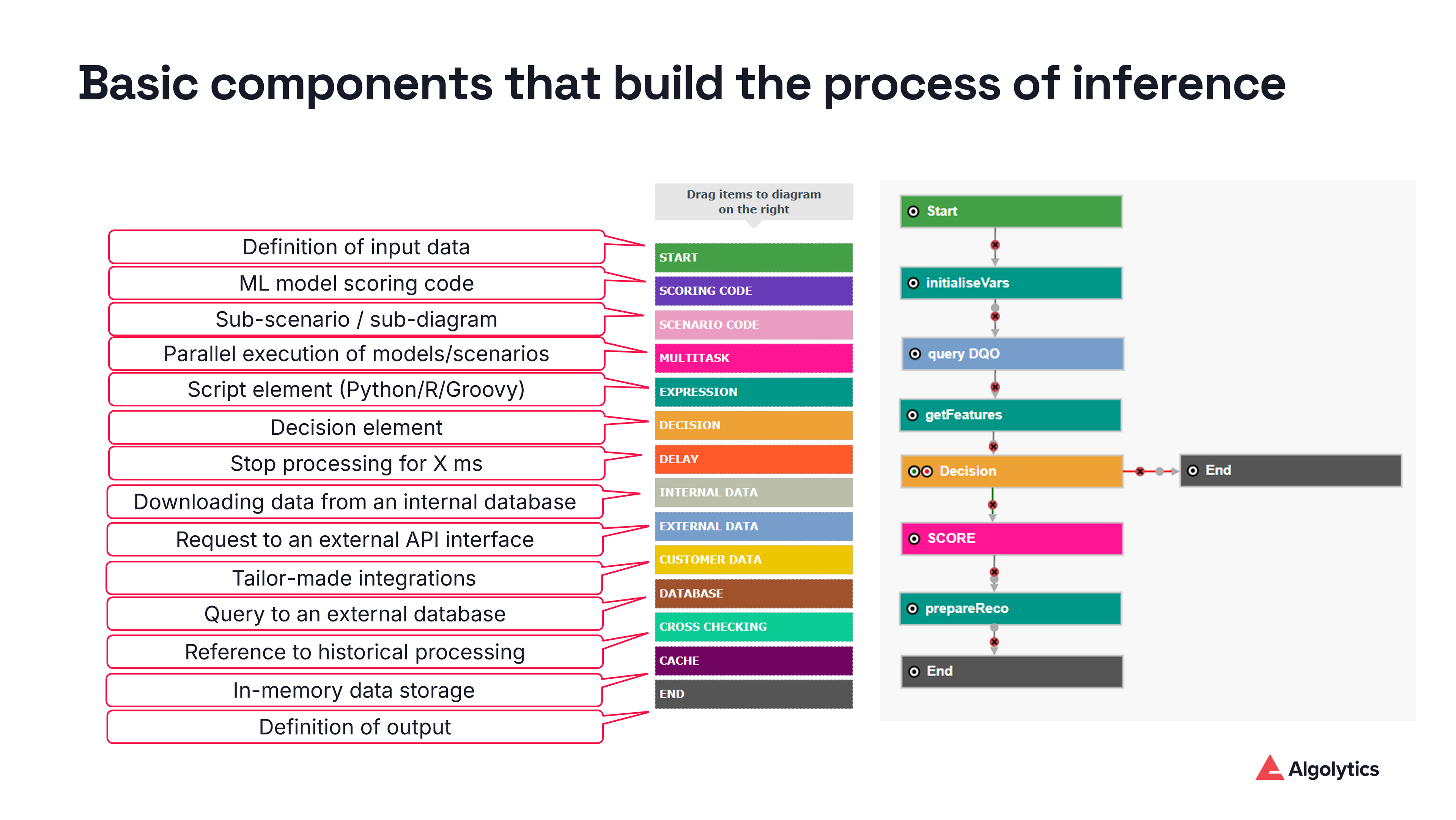
Typical building blocks include inputs and outputs, database and API integrations, feature retrieval, model scoring, business rules, and custom logic written in Python, R or Groovy where needed.
This enables a more streamlined workflow, where the person closest to the business problem can design, test, and deploy the full decision flow with fewer handoffs. Developers can still extend the logic, but avoid implementing repetitive infrastructure concerns such as HTTP handling, connection management, retry logic, or routing.
This approach simplifies deployment while preserving full control over complex decision logic and integrations.
Event Engine: Real-Time Streaming and Feature Store
Event Engine processes high-volume event streams and transforms them into features associated with specific objects, such as customers, devices, or bike stations.
For each object, it maintains rolling feature vectors based on time windows - for example, the number of transactions in the last 50 minutes or the number of bike returns in the last three hours.
The real-time loop updates features and triggers scoring as events arrive, enabling immediate decision-making. The batch loop aggregates historical data, generates training datasets, and feeds them into AutoML for model retraining.
This allows models to be continuously updated and redeployed as new data becomes available.
Feature definitions are versioned, and changes can be introduced in production without restarting the system. This reduces the gap between experimentation and production and makes it easier to adapt models to changing data.
Case Study 1: New York City Bike Rental Prediction
We conducted a demo using public NYC Citi Bike data.
The application combined historical data for model training with live data feeds, including station capacity, available bikes, and rental and return events. Event Engine was responsible for real-time feature generation, while Scoring.One handled prediction and decision logic.
Event Engine created station-level features such as recent rentals, recent returns, capacity utilization, and time-based aggregates. These features were exposed via API and used by Scoring.One to predict the net inflow of bikes over the next 50 minutes.
The output was not limited to a numerical prediction. It was translated into operational decisions, such as “rebalance required” or “no action required,” with error handling for invalid station identifiers.
A web interface displayed a map of New York with current station statuses. Under the hood, the UI called a Scoring.One endpoint, passed a station identifier, and received the corresponding decision.
The full solution was built in a few hours. Most of the effort went into understanding and preparing the data, while the integration and deployment itself took approximately 1–2 hours.
Importantly, the system achieved an average response time of around 9 milliseconds, which included feature retrieval, model execution, and business rule evaluation, demonstrating low-latency performance suitable for real-time applications.
Case Study 2: Location-Based Business Recommendations
We also conducted a second demo focused on location intelligence. In this scenario, a user provides an address or coordinates, and the system recommends which types of businesses are best suited for that location.
The application combined approximately 100 predictive models and around 1000 features to calculate look-alike scores across different business categories. Based on these scores, Scoring.One returned the top recommendations.
The decision flow followed a clear structure: starting from the location input, the system retrieved spatial and demographic features, executed multiple models in parallel, aggregated and ranked the results, and returned the most relevant business types.
This pattern generalizes to a wide range of use cases where multiple models and feature sets are combined to produce ranked outputs, including retail site selection, real estate analysis, branch placement, logistics planning, and customer intelligence.
How Algolytics Supports Key Enterprise Use Cases
The same architecture can support a wide range of enterprise applications, where different MLOps capabilities become critical depending on the use case.
In credit scoring, the focus is on explainability, governance, and controlled model deployment. Fraud detection requires real-time feature processing, low-latency scoring, and continuous monitoring. In marketing applications such as next-best-offer, batch and real-time scoring need to be combined, while churn prediction depends on feature reuse, monitoring, and lifecycle management.
Other use cases, such as dynamic pricing or location intelligence, rely on fast inference, live data integration, business rule orchestration, and the ability to run multiple models in parallel.
Across all these scenarios, the underlying architecture remains the same - it combines feature engineering, model execution, and decision logic into a single system.
Algolytics’ scoring platform and Data Quality / Location Intelligence tools are built on this shared foundation. They integrate with enterprise systems such as data warehouses, CRM, ERP, and BI platforms, as well as cloud and on-premise environments.
This integration is critical in practice: instead of moving data to isolated ML environments, models access enterprise data directly from source systems, while the computation is executed within the Scoring.One runtime. This reduces operational complexity and enables faster decision-making.
Practical Guidance: When and How to Adopt an MLOps Platform
You have likely outgrown ad-hoc model deployment if you observe signs such as multiple models in production, frequent retraining needs, growing DevOps backlog, rising infrastructure costs, lack of monitoring, or difficulty updating models and business rules.
A practical approach is to start with one or two high-impact use cases, such as credit scoring or fraud detection. Focus on measurable factors, including latency, cost per prediction, integration effort, and operational constraints.
Instead of trying to standardize every component upfront, prioritize integrating model execution, feature processing, and decision logic into a single system. This reduces fragmentation and allows teams to move faster from experimentation to production.
As the system matures, monitoring, versioning, and controlled deployment can be introduced progressively within the same environment, rather than through separate tools and pipelines.
FAQ
How is an MLOps platform different from a standard model deployment tool?
A deployment tool typically exposes a single model as an endpoint. An MLOps platform manages the full lifecycle, including data preparation, model training, deployment, monitoring, and governance.
Algolytics combines AutoML, Scoring.One, and Event Engine into a single system, allowing teams to build complete decision workflows rather than isolated endpoint.
Can I use Algolytics' MLOps with models built in Python, R, or other frameworks?
Scoring.One supports models built in Python, R, PMML, and external APIs.
Internally generated models can be converted into optimized Java code for performance, but teams can freely combine different technologies within a single system.
Do I need Kubernetes or heavy DevOps skills to run this type of MLOps platform?
Not necessarily. Algolytics uses a lightweight, event-driven architecture, so many deployments do not require complex Kubernetes setups.
DevOps teams still manage infrastructure, security, and cloud environments, but everyday changes - such as updating models or business rules - can be handled by data science teams using low-code tools.
How does the platform handle continuous monitoring and model degradation?
Scoring.One tracks operational metrics such as latency, errors, and throughput.
The platform also supports monitoring of model performance, data drift, and prediction distributions. Event Engine and AutoML can generate updated datasets from both real-time and historical data, enabling retraining and validation before deployment of new mode
What deployment methods are supported: batch, real-time, or streaming?
Algolytics supports batch processing, real-time APIs, and streaming scenarios.
Batch is suitable for offline scoring and reporting. Real-time APIs support interactive applications. Streaming is used for scenarios such as fraud detection, transaction monitoring, or IoT systems, where decisions must be made as events occur.
If you're considering adopting an MLOps platform, start with a single high-impact use case and benchmark it under realistic load - focusing not only on model accuracy, but also on latency, cost, and operational complexity.
For a deeper dive into the architecture and the demos presented in this article, we encourage you to watch our latest webinar "How to build, deploy and scale ML applications faster & at lower cost?".
If you'd like to see how an integrated MLOps platform works in practice, or discuss your specific use case, feel free to reach out to us.