4 minutes
In the context of increasing regulatory pressure and ambitious climate policy goals, access to high-quality data on building energy efficiency, along with analytical tools to study the phenomenon, is becoming a key element of the energy transition.
Algolytics, a provider of advanced analytical tools and location data, has developed a solution that enables the prediction of the energy characteristics of residential buildings—leveraging its proprietary data sources and the AutoML platform Automatic Business Modeler (ABM).
Application of the tool for predicting the energy efficiency of single-family buildings
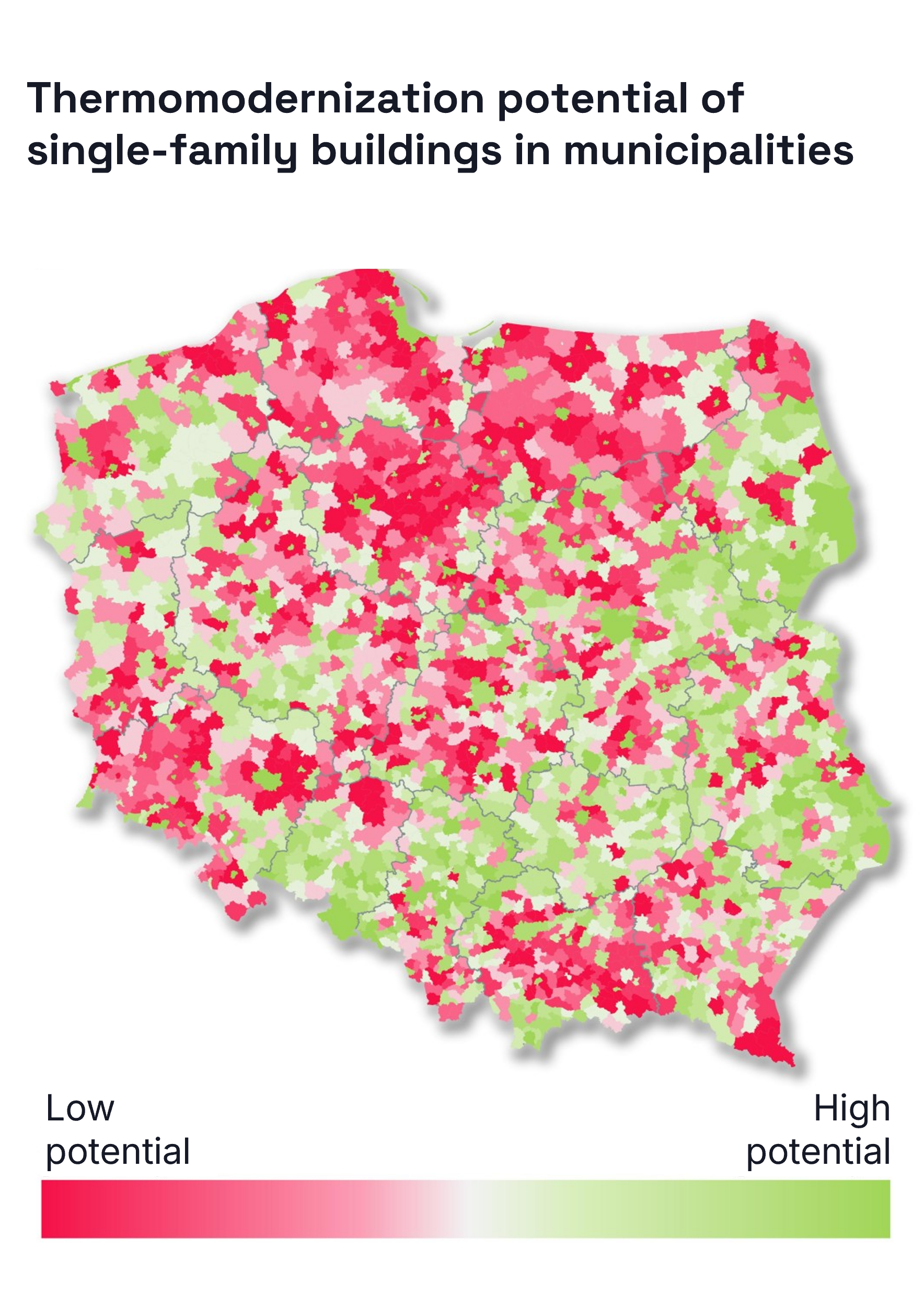
The tool we developed enables the identification of residential buildings with low energy efficiency (classes D–G according to the planned classification by the Ministry of Development and Technology), and then estimates the thermomodernization potential at the municipal level across Poland. The project addresses the needs of various stakeholder groups, including:
- banks – for targeting green financial products,
- local governments (LGUs – local government units) – for planning energy policy and implementing subsidy programs (e.g., “Clean Air,” National Recovery Plan),
- energy companies and ESCOs (Energy Service Companies) – for preliminary qualification of properties for modernization,
- developers and property managers – for assessing real estate portfolios in terms of energy efficiency.
Source data and methodology for predicting energy efficiency – CHEB and Location Intelligence
The input data came from the Central Register of Building Energy Performance (CHEB), which includes energy consumption indicators:
- EU – demand for usable energy,
- EK – demand for final energy,
- EP – demand for non-renewable primary energy (the key indicator for energy classification).
This information was enriched with spatial and socioeconomic data from Algolytics’ Location Intelligence system – including detailed building characteristics (year of construction, type, number of floors), demographic and income data, urban surroundings, types of development, and POIs (points of interest – e.g., shops, schools, services, transport).
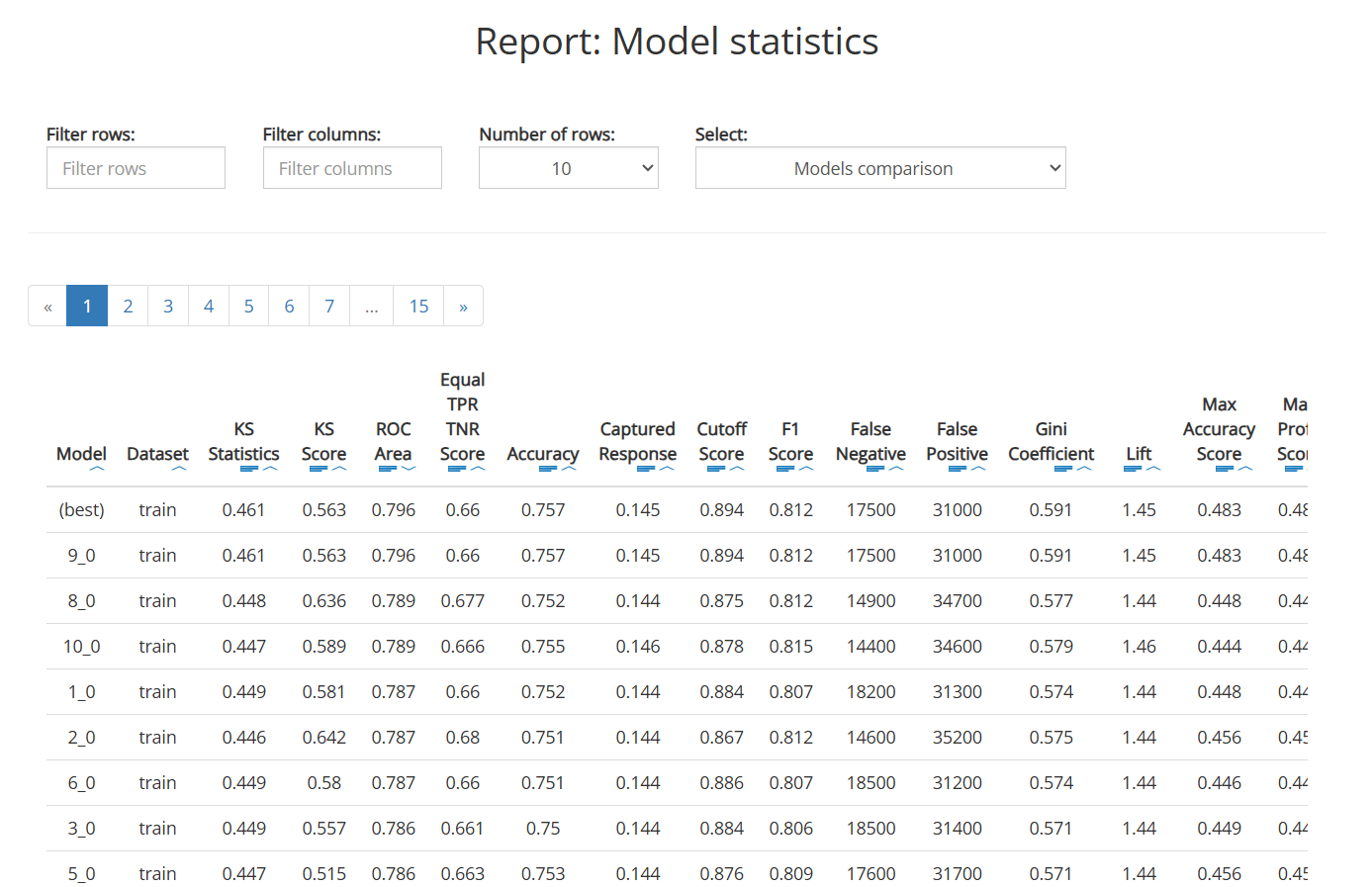
The modeling process used AutoML ABM technology, which automates the entire pipeline: from feature selection and engineering to model selection and tuning. The final model achieved very strong predictive performance, with a ROC AUC of approximately 80%.
Integration process of spatial data and energy efficiency modeling
To train the model, we followed these steps:
- Energy data from CHEB was acquired and matched with the Algolytics database for single-family buildings.
- The target variable was defined: 1 – classes D/E/F/G, 0 – all others.
- The modeling process was carried out in ABM, using a rich set of location-based features.
- The remaining single-family buildings in the Algolytics database were scored.
- An aggregated thermomodernization potential index was calculated for all municipalities in Poland.
Results of thermomodernization potential scoring – location analytics in action
The AutoML model uses around 100 features describing the building, its surroundings, and the socio-demographic characteristics of its residents.
The model’s predictive accuracy is ROC AUC 80% (GINI 60%).
Below are projections of scoring assessments for several areas:
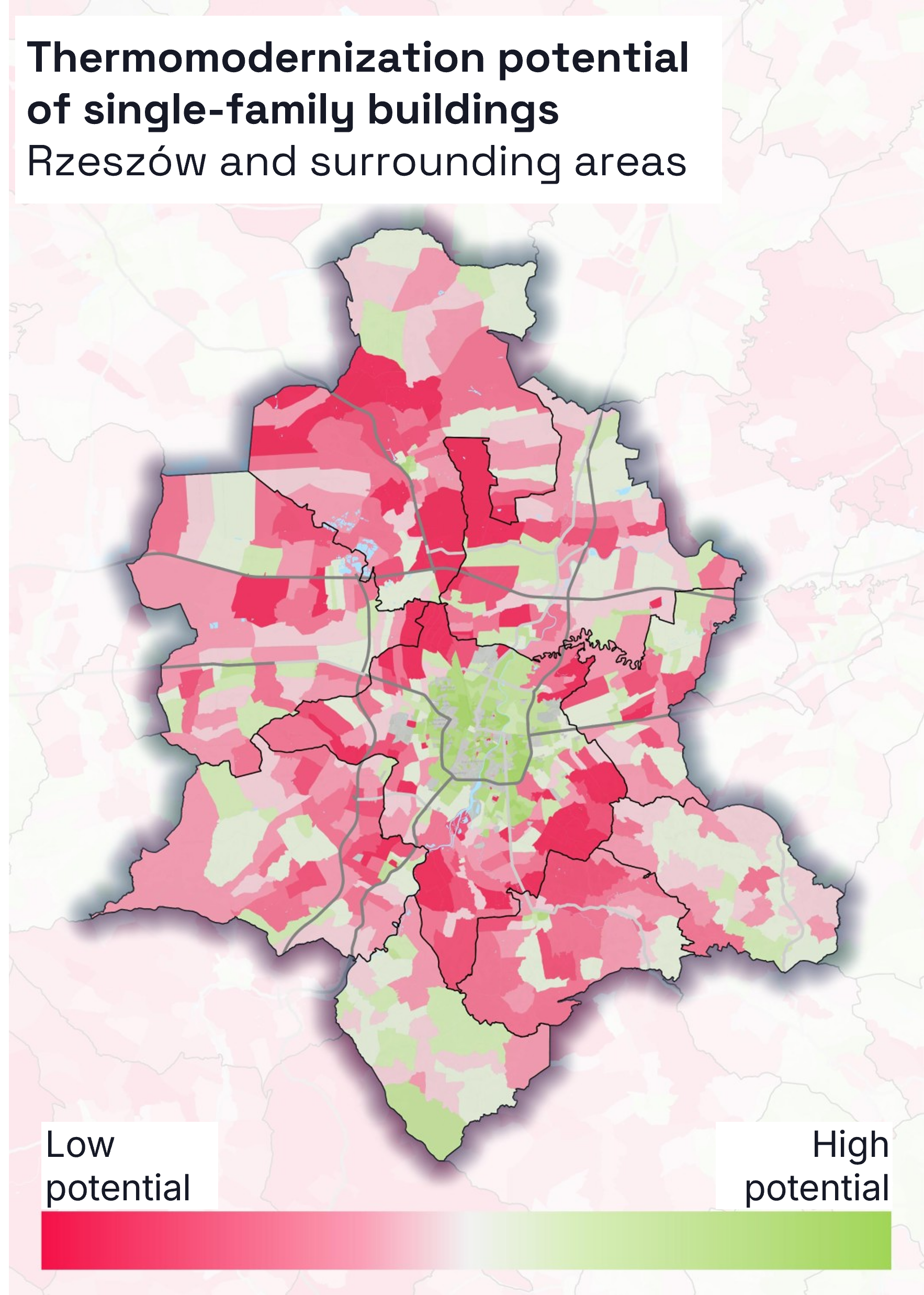
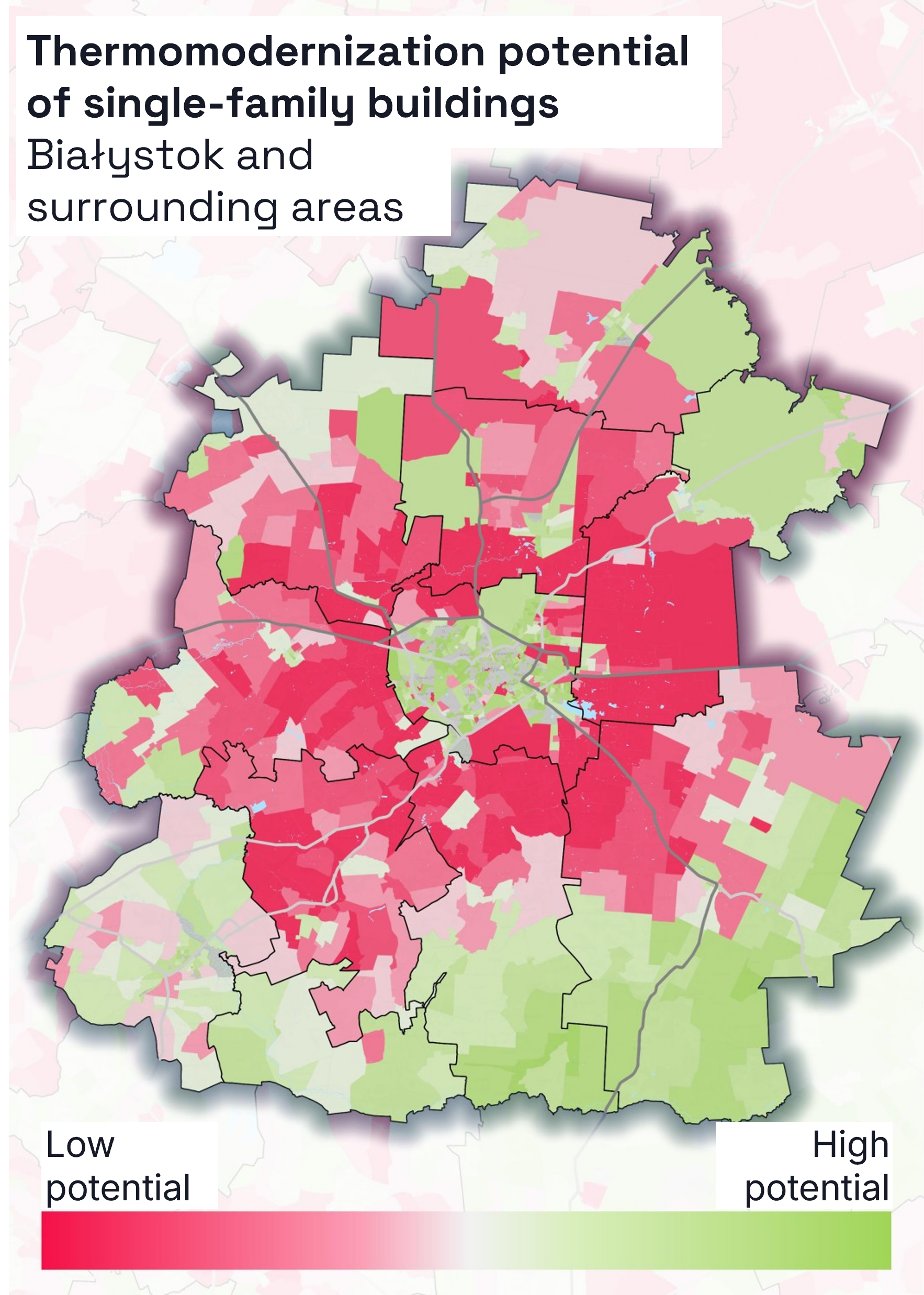
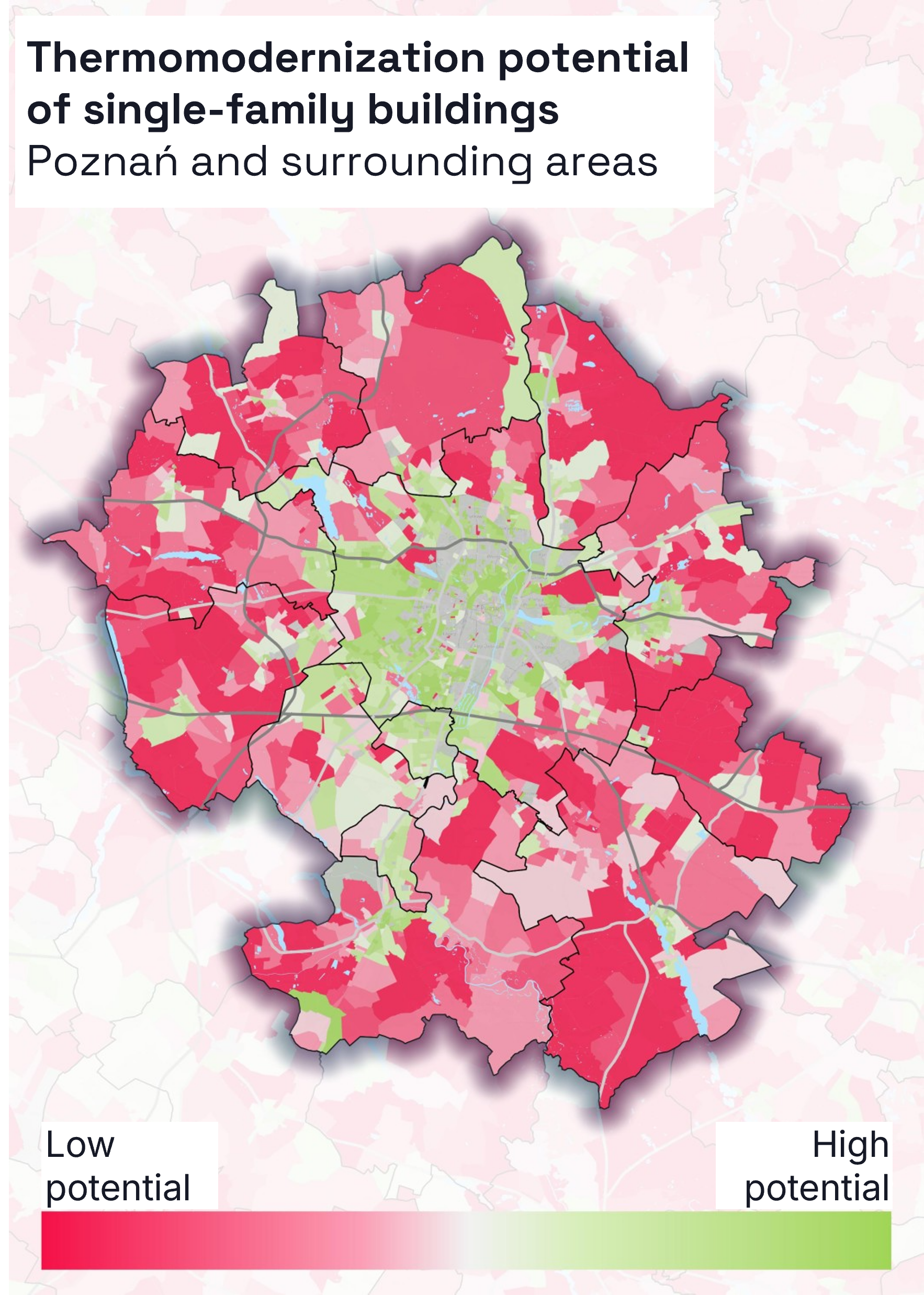
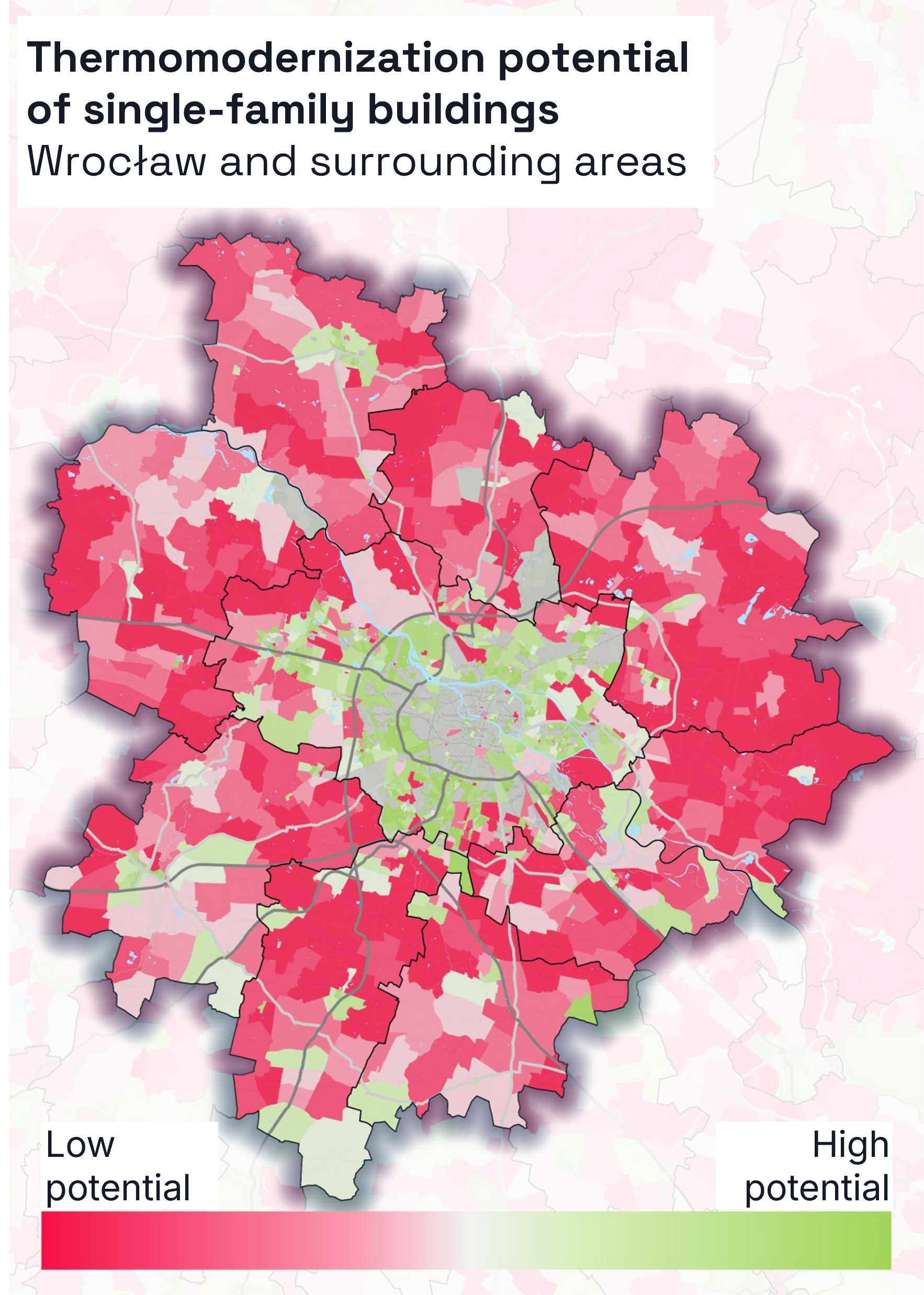
We observe a characteristic pattern — single-family buildings located within urban areas tend to have low energy efficiency. Suburban areas, on the other hand, feature newer construction built according to higher thermal insulation standards.
Practical applications of the predictive model for building energy efficiency
Such a model can be used for:
- Targeting door-to-door activities by companies implementing modernization programs,
- As a component of CRM systems to prioritize contacts with residents of low-efficiency homes,
- Identifying “green investment opportunities” by financial institutions,
- Supporting strategic decision-making for local governments (LGUs) and infrastructure companies planning territorial interventions.
Regulatory context and the role of EP prediction in ESG policy and energy classification
The model fits into the broader context of regulatory changes— including the draft regulation by the Ministry of Development and Technology (MRiT) introducing mandatory energy classification of buildings (from A+ to G). The EP indicator will become the basis for this classification, and its knowledge and prediction will gain importance both in real estate transactions and in the context of ESG (Environmental, Social, and Governance) initiatives, which increasingly determine access to capital and public support.
Development plans: predicting energy efficiency for multi-family and public buildings and integration with real estate valuation models
The project is planned to be expanded to other property types (multi-family, public) and to integrate EP prediction with real estate valuation models and rental market demand analysis. Analyzing transformation potential at the micro-region level may soon become a standard component of ESG policies, spatial planning, and energy service design.
If you want to learn more about Algolytics’ Location Intelligence technology and AutoML, feel free to contact us.