Definitions
- attributes - variables,
- levels - subdivisions of the set of values of a variable used in the scoring card; in the case of categorical variables levels mean different values of an attribute (also called categories), in the case of numerical variables levels mean intervals.
Notation
 - the number of attributes,
 - the attributes,
 ,
,
 - the number of levels for the attribute
 ,
,
 - the number of a level for the attribute
 ,
,
 .
.
The first step in building scoring card is to determine levels for attributes.
For every attribute
 the algorithm sets
 -- the number of levels.
If an attribute is categorical the number of levels equals the
number of different values (different categories).
For numerical attributes the algorithm selects intervals.
-- the number of levels.
If an attribute is categorical the number of levels equals the
number of different values (different categories).
For numerical attributes the algorithm selects intervals.
In both cases two extra levels ('No Answer' and 'No information') are added by defaul:
- The No Answer level means that customer deliberately didn't provide an answer. This category adds an additional source of information about the customer's behavior. Is it assumed that purposeful hiding of information by the customer is equivalent to the least-profitable answer for him.
- The No Information level- means lack of data due to factors other than purposeful non-disclosure of information on the part of the customer, such as database system errors. This category doesn't provide any additional information and is treated as a missing value or an error.
In the case when any of the two additional levels is not necessary, it can be deleted manually.
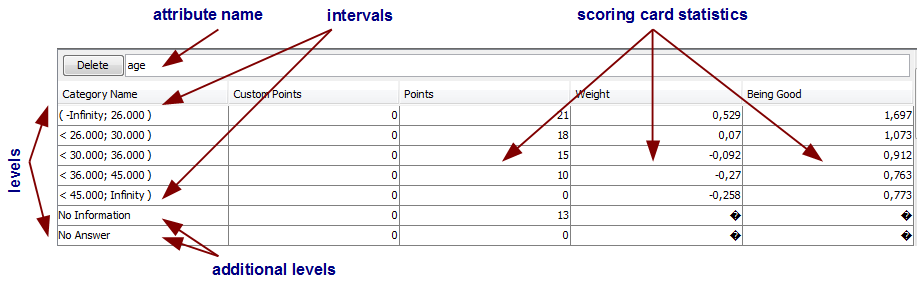
In the process of building a scoring card, the algorithm calculates the number of points for every level of every attribute. Two algorithms for calculating points are available: Max Points Scaling and PDO Scaling. Moreover, additional scoring card characteristics, the BeingGood and Weight of Evidence parameters are also caluclated.
The main component of the formula for calculating the points for
the  -th
level of attribute
-th
level of attribute  is the contribution coefficient
 . These coefficients are
calculated differently for categorical and numerical attributes.
. These coefficients are
calculated differently for categorical and numerical attributes.
Priot to the calculation, every categorical attribute
 is binarized into
 binary variables. Let
  denote the coefficient obtained from
the logistic regression model for the variable (obtained from binarization)
corresponding to the
denote the coefficient obtained from
the logistic regression model for the variable (obtained from binarization)
corresponding to the
 -th
level of the attribute
-th
level of the attribute  .
.
The contribution coefficient for the
 -th
level of the categorical attribute
-th
level of the categorical attribute
 is calculated as:

Additionally, for the No Information level

where
 is the number of records in the training dataset
for which the value of the attribute
is the number of records in the training dataset
for which the value of the attribute  belongs to the
 -th
level,
-th
level,
 is the number of records in the training dataset
for which the value of the attribute
is the number of records in the training dataset
for which the value of the attribute  is specified (i.e. non-missing).
Let  denote the average value of the attribute
  in the training dataset,
and
in the training dataset,
and  the average value of the
  -th
level of the attribute
-th
level of the attribute  . In the case when the level is empty (i.e. no values
fall into it), we put
. In the case when the level is empty (i.e. no values
fall into it), we put
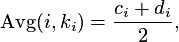
where  and
and  denotes the ends of the interval which forms the
  -th level.
When the level is empty and one of the ends of the corresponding interval is equal to
-th level.
When the level is empty and one of the ends of the corresponding interval is equal to
 , the value of
  is set to the othe end of the interval.
Let  denote the coefficient obtained from the logistic regression model for the attribute
 .
.
The contribution coefficient for the  -th level of the attribute
  is calculated as

and

Note
The formula for the contribution of the No Information level of a numerical variable is, in fact, similar, to the one for categorical variables. It can be shown that:

For the standard levels and the No Information level the algorithm
first calculates the non-normalized points and later uses the
non-normalized points for all levels of a given attribute to calculate the normalized points
for each level. Below we assume that  corresponds to the No Information
level of the attribute
corresponds to the No Information
level of the attribute  .
.
For the level  of the attribute
  the non-normalized points (
 ) are calculated according to the formula

where

 is an input parameter equal to the number of points assigned to the
strongest attribute,
is an input parameter equal to the number of points assigned to the
strongest attribute,  if the SwapPoints
paramter of the algorithm settings
is set to true, and
if the SwapPoints
paramter of the algorithm settings
is set to true, and  if the
SwapPoints> paramter is set to false.
if the
SwapPoints> paramter is set to false.
The normalized points for any level with the exception of No Answer level are calculated according to the formula

For the No Answer level the following formula is used

if the Maximum for NoAnswer paramater of the algorithm settings is set to true, and

if the Maximum for NoAnswer paramater is set to false.
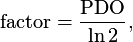
The PDO (Points to Double the Odds) Scaling algorithm depends on three parameters: odds, atPoints and PDO. The points for various levels are calculated so that the score of atPoints corresponds to the odds (of obtaining a positive target value) of odds : 1 and these odds double with every increase of the total score by PDO points.
Priot to the calculation, every categorical attribute
 is binarized into
 binary variables. Let
  denote the coefficient obtained from
the logistic regression model for the variable (obtained from binarization)
corresponding to the
denote the coefficient obtained from
the logistic regression model for the variable (obtained from binarization)
corresponding to the
 -th
level of the attribute
-th
level of the attribute  .
.
The contribution coefficient for the
 -th
level of the categorical attribute (other than NoInformation
and NoAnswer)
-th
level of the categorical attribute (other than NoInformation
and NoAnswer)
 is calculated as:

where
 is the
Weight of Evidence parameter.
Additionally
is the
Weight of Evidence parameter.
Additionally

For a given attribute
 let
let
 denote the coefficient obtained from logistic regression.
For any level
denote the coefficient obtained from logistic regression.
For any level
 ,
of this attribute which is other then the
NoInformation and NoAnswer
the contribution is calculated according to the formula
,
of this attribute which is other then the
NoInformation and NoAnswer
the contribution is calculated according to the formula

where
 is the
Weight of Evidence parameter.
The contribution for the NoInformation level is
calculated as
is the
Weight of Evidence parameter.
The contribution for the NoInformation level is
calculated as

Let
 denote the number of attributes. Prior to point assignment
the following quantities are calculated:
denote the number of attributes. Prior to point assignment
the following quantities are calculated:

The the points for the attribute
 and its level
 (other than NoAnswer)
are calculated as
(other than NoAnswer)
are calculated as

where
 is the intercept term obtained from
from logistic regression and
is the intercept term obtained from
from logistic regression and  if the
SwapPoints> paramter is set to false.
if the
SwapPoints> paramter is set to false.
For the No Answer level the following formula is used

if the Maximum for NoAnswer paramater of the algorithm settings is set to true, and

if the Maximum for NoAnswer paramater is set to false.
The BeingGood statistic is calculated for every level of every attribute according to the following formula:

where
 is the
number of records in the training dataset for which the
value of the attribute
is the
number of records in the training dataset for which the
value of the attribute  belongs to the
 -th
level and is not the positive target value.
-th
level and is not the positive target value.
 is the
number of records in the training dataset for which the
value of the attribute
is the
number of records in the training dataset for which the
value of the attribute  belongs to the
 -th
level and is the positive target value.
-th
level and is the positive target value.
 is the total
number of records in the training dataset for which the
value of the attribute
is the total
number of records in the training dataset for which the
value of the attribute  is not
the positive target value.
is not
the positive target value.
 is the total
number of records in the training dataset for which the
value of the attribute
is the total
number of records in the training dataset for which the
value of the attribute  is
the positive target value.
is
the positive target value.
The Weight of Evidence parameter is calculated for every level of every attribute according to the formula
