The binary target (dependent) value splits the learning data sample into two subpopulations. The purpose of the linear discriminant function estimator is to predict whether a particular observation belongs to the first or the second subpopulation on the basis of the values of explanatory attributes.
Let
 be a vector of explanatory attributes
(a single observation). The binary linear discriminant is the function:
be a vector of explanatory attributes
(a single observation). The binary linear discriminant is the function:

where
 are the
vectors of the mean values of the explanatory attributes for the two
populations, and
are the
vectors of the mean values of the explanatory attributes for the two
populations, and
 is the covariance matrix of the two
populations, defined as
is the covariance matrix of the two
populations, defined as

Using the linear discriminant function value, the model assigns an observation to one of the two possible classes on the basis of the classification function:
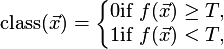
where T is the classification threshold value:
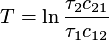
,
 is the a-priori frequency of
the respective population (i.e. its size in the learning sample), and
is the a-priori frequency of
the respective population (i.e. its size in the learning sample), and
 is the cost of misclassification, i.e.
mistakenly assigning an observation from the class i to the class j.
Such costs can be specified in
AlgorithmSettings.
is the cost of misclassification, i.e.
mistakenly assigning an observation from the class i to the class j.
Such costs can be specified in
AlgorithmSettings.
Discriminant analysis is a typical supervised learning algorithm. The training set is made of two populations. The assignment of an observation to one of the subpopulations is determined by the binary dependent (target) attribute. Observations in both populations are assumed to be described by the same set of explanatory attributes. The basic assumption of linear discriminant model, which differentiates it from the logistic regression model, is that within-group attribute distribution is approximately multivariate normal.
Another important assumption of the linear model is that the covariance matrices of both populations are equal. This assumption in general case is not satisfied, so algorithm settings allow the choice between the covariance matrix of the first population, the covariance matrix of the second population or the average of both matrices.
If the normality assumption is not fulfilled, the user might consider using the logistic regression model instead. On the other hand, if both above mentioned assumptions hold, the binary discriminant model is supposed to be more effective in terms of classification error rate.